M&A deal volume steady in first half of 2026

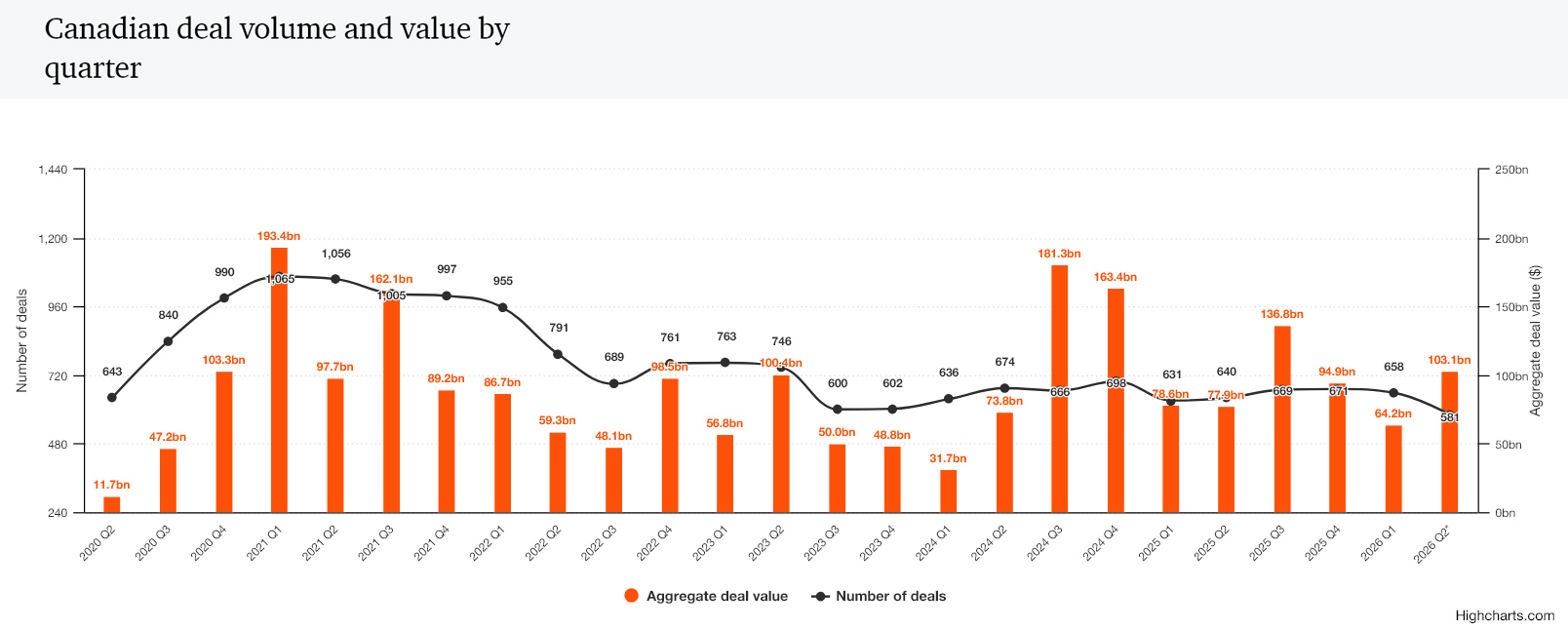
Canadian M&A deal volume remained relatively steady in the first half of 2026, according to PwC’s mid-year M&A update report.
There were 658 deals in Q1, close to the quarterly average of 653 in the prior year. PwC projects a decline to 581 deals in Q2, as companies assessed the impact of the Iran conflict and higher energy prices – but activity across the first half remains relatively consistent with prior periods.
Aggregate deal value was $64 billion in Q1, below the 2025 average of $97 billion. Average deal size also eased in Q1, at approximately $98 million compared to the 2025 average of $148 million.
Materials, industrials, and IT remained the top three sectors in H1 2026, accounting for over a third of all deals. Financial services softened in the second half, while real estate hovered around 2025 lows.
PwC’s report points to a more uncertain context for dealmakers in the second half of 2026, as Canada’s real GDP growth is projected to underperform at 0.9% to 1.3% and inflation is expected to reach 2.5% to 3.0%. There is also continuing trade volatility, including uncertainty about Cusma – a major risk for Canadian sectors reliant on the United States.
“This is exactly why M&A has become so critical right now. By building scale at home and strengthening their supply chains, companies are protecting themselves against international headwinds,” said Sean Rowe, national leader for deals markets and value creation at PwC Canada.
Internationally, Canadian deal activity remained heavily skewed toward the US, with more outbound transactions into the US than inbound into Canada.
The PwC report examined three major sectors: energy, agrifood, and insurance.
The Iran conflict created supply shock tailwinds for Canadian producers (although oil prices have currently fallen to pre-war levels on the back of a 60-day memorandum of understanding). The volatility has added inflationary pressure, however, and raised diligence requirements and potential increases for borrowing costs.
PwC says that climate volatility and geopolitical shocks have made food resilience a strategic priority. The firm expects increased public funding and a stronger appetite to build ecosystems to provide an impetus for M&A activity in the sector.
In insurance, foreign companies are reassessing their Canadian operations and providing an opportunity for domestic carriers to acquire platforms. Recent deals – such as Definity’s acquisition of Travelers Canada and Wawanesa’s acquisition of Everest Insurance Company of Canada – point to this shift.
“Deals are how reinvention happens at speed. Companies can acquire capabilities faster than they can build them,” the PwC report concludes. “In a market defined by global instability and shifting value pools, the dealmakers who move with conviction won’t just close transactions. They’ll reinvent how they compete.”